| « When is a Protein a Protein? | Luminese » |
Youthful Glow
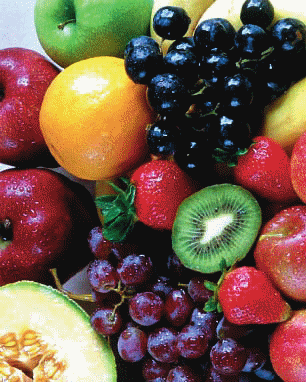
Ingredient To Die For is very excited to introduce Youthful Glow, it is a concentrated blend of five botanical extracts: bilberry, sugar cane, sugar maple, orange, and lemon. These extracts contain several naturally occurring alpha hydroxy acids. Alpha hydroxy acids have been shown to promote smoother, younger looking skin by increasing the rate of cell renewal. Alpha hydroxy acids (AHAs) have been used in skin care for many years. At first, they were used mainly by dermatologists as skin peeling and moisturizing agents; cosmetic companies have since “discovered” AHAs and their almost miraculous activity and formulate with them regularly in their skin care lines. Youthful Glow is produced by taking several species of plants and running them through an exhaustive extraction process, which reduces color and odor, and concentrates the active principles.
Once blended, the extracts are concentrated by vacuum distillation until a specified concentration of actives is achieved. The product is then filtered to eliminate any particulate matter. Since Youthful Glow is a natural product it will contain a wide variety of residual natural substances, such as cellulose, carbohydrates, proteins, water soluble vitamins and minerals
When the process is complete, the material contains the following concentrations of alpha hydroxy acids:
| Lactic Acid 28-32% | Glycolic Acid 12-17% |
| Citric Acid 2-6% | Malic Acid 1% max |
| Tartaric Acid 1% max |
The primary action of AHAs lies in their keratolytic ability — they weaken bonds that hold dead skin cells together. When these bonds are weakened, the dead cells can be shed from the surface of the skin, resulting in skin that appears fresher, smoother, and younger. Although the keratolytic activity of AHAs is very important, it is also interesting to note that many AHAs function as intermediates in several key metabolic pathways. Glycolysis, a process which involves the oxidation of glucose to pyruvic acid, is a key pathway of the cellular energy process. Hydrolysis of pyruvic acid leads to the formation of lactic acid. Lactic acid is a highly effective moisturizer. In studies, it has been shown to increase the synthesis of glycosaminoglycans. Glycolic acid exhibits the most keratolytic ability of any of the AHAs. It is glycolic acid that is responsible for the immediate skin softening effect felt by consumers when they fi rst use an AHA product. Citric acid, when topically applied, stimulates collagen synthesis. Both tartaric and malic acid boost skin elasticity. To combine all of these AHAs results in a truly multifunctional material.
Natural Versus Synthetic Alpha Hydroxy Acids
The debate over natural versus synthetic AHAs has raged for several years. With the advent of Youthful Glow, it seems that we have combined natural purity with excellent activity. While AHAs have a potential to be irritating to skin, they also effectively stimulate cell renewal. The Therapeutic Index1 of AHAs shows the ratio of stimulation to irritation. The graph below shows that the activity of Youthful GlowYouthful Glow surpasses the activity of the synthetic lactic and glycolic acids. In Youthful Glow, we have maximized the ability to stimulate cell renewal, while minimizing the potential for irritation.
Efficacy Studies — Dansyl Chloride Staining
Youthful Glow was evaluated in both aqueous solutions (10%) and in a commercially available cosmetic cream (4%), via a dansyl chloride cell renewal protocol. Panelists were patched for 24 hours with 5% dansyl chloride in a petrolatum base. All subjects were examined on Day One with quartz mineral UV lamps (long and short wave) to ensure that the fl uorescent stain had been taken up by the stratum corneum layers. Test materials were then applied to sites on the volar forearm.
At a 10% dilution, Youthful Glow produced a 34% increase in cell renewal when compared to the untreated control site. Accordingly, there was a 143% increase in the number of squames generated. Evaluated at 4% in a commercial cream, Youthful Glow increased cell turnover by 20% relative to the control formulation. This data collectively, correlates with Youthful Glow’s ability to stimulate cell renewal.
 This entry was posted on Oct 17, 2008 at 11:48 am by blogger and is filed under Latest News, General Discussion, Personal Care Trends.